
The group fitness world is full of strong brands—Barry’s, F45, Orangetheory, and CrossFit—all offering high-energy training in structured class formats. While they may seem similar from the outside, each model is built on a different training philosophy. Understanding those differences helps you decide which approach best fits your goals, whether you’re seeking motivation, measurable progress, variety, or long-term development.
Barry’s (formerly Barry’s Bootcamp)
Barry’s, previously known as Barry’s Bootcamp, is built around a signature interval format that switches between treadmill running and strength training on the floor. The atmosphere—red lighting, loud music, and a nightclub-like vibe—is an essential part of the experience. Participants come for a workout that feels energising, immersive, and intense.
While the structure delivers a strong cardiovascular and muscular challenge, Barry’s is designed primarily as a consistent experience rather than as a progressive training system. The format remains relatively fixed, and the purpose of the class is to deliver a specific style of session rather than to develop all physical capacities equally across time.
F45 Training
F45’s core feature is its library of templated programs. Each day of the week has a pre-defined class type (cardio, resistance, hybrid), and studios worldwide follow the same structure. Stations, screens and timed intervals create variety and simplicity.
F45 serves people who enjoy circuit-style workouts without complex skills or heavy lifting. Because the model is standardized for a global audience, the training intentionally avoids elements that require individualized progression or extensive coaching. It is broad, accessible, and time-efficient, but it does not aim to cover the full range of fitness attributes.
Orangetheory Fitness
Orangetheory focuses primarily on heart-rate-based conditioning. Participants rotate between treadmills, rowers, and light resistance work while tracking their heart-rate zones on screens.
The strength of Orangetheory lies in its clear structure and immediate feedback, which can be highly motivating—especially for beginners or those who enjoy data-driven cardio sessions. However, the model emphasizes endurance and general conditioning, with less emphasis on strength, power, agility, or skill development.
CrossFit: A broader training method with measurable results
CrossFit is often compared to the brands above simply because it’s delivered in a group format. In practice, CrossFit is fundamentally different because it operates as a training method, not a single class template.
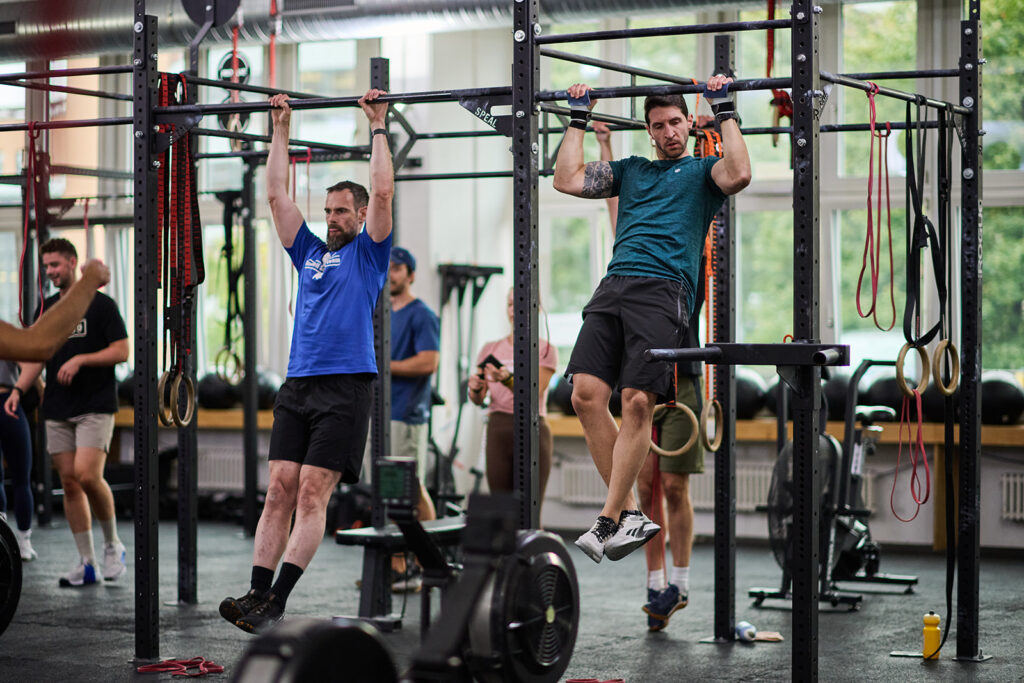
CrossFit combines strength training, conditioning, gymnastics, power development, speed, agility, endurance, and skill work. The aim is to develop a wide range of physical capacities that support long-term fitness and health.
A defining feature of CrossFit is measurability. Workouts often track load, time, distance, or repetitions, allowing individuals to see tangible progress over months and years—not just from session to session.
CrossFit is also scalable. Movements can be adjusted in load, complexity, or range of motion so that people of different ages, abilities, and training histories can complete the same workout with appropriate variations. This makes it possible to train for decades within the same method, continually adapting as goals and physical needs evolve.
The key difference: Narrow models vs. broad training methods
Each system has a clear purpose:
- Barry’s delivers a high-energy interval experience within a recognisable format.
- F45 offers templated circuit sessions that prioritise accessibility and variety.
- Orangetheory provides structured cardiovascular training supported by heart-rate feedback.
- CrossFit applies a broad training method designed to improve multiple dimensions of fitness simultaneously.
It is not about which option is “better.” Instead, the difference lies in scope.
Barry’s, F45, and Orangetheory operate within defined, narrower models. CrossFit spans a wider range of fitness qualities and uses measurable data to support long-term progression.
For someone who wants an intense, predictable experience, Barry’s is a strong choice. For those wanting a comprehensive, multi-dimensional training method and measurable results, CrossFit offers a different—and broader—approach.